
Filing a discrimination charge is not the end of the process. It begins an administrative process that may include intake and jurisdiction review, notice to the employer, requests for information, mediation, investigation, and ultimately a decision about how the agency will close or proceed with the matter.
Knowing which stage you are in can help you understand what information matters and when legal advice may become particularly important.
What happens after you file a discrimination charge?
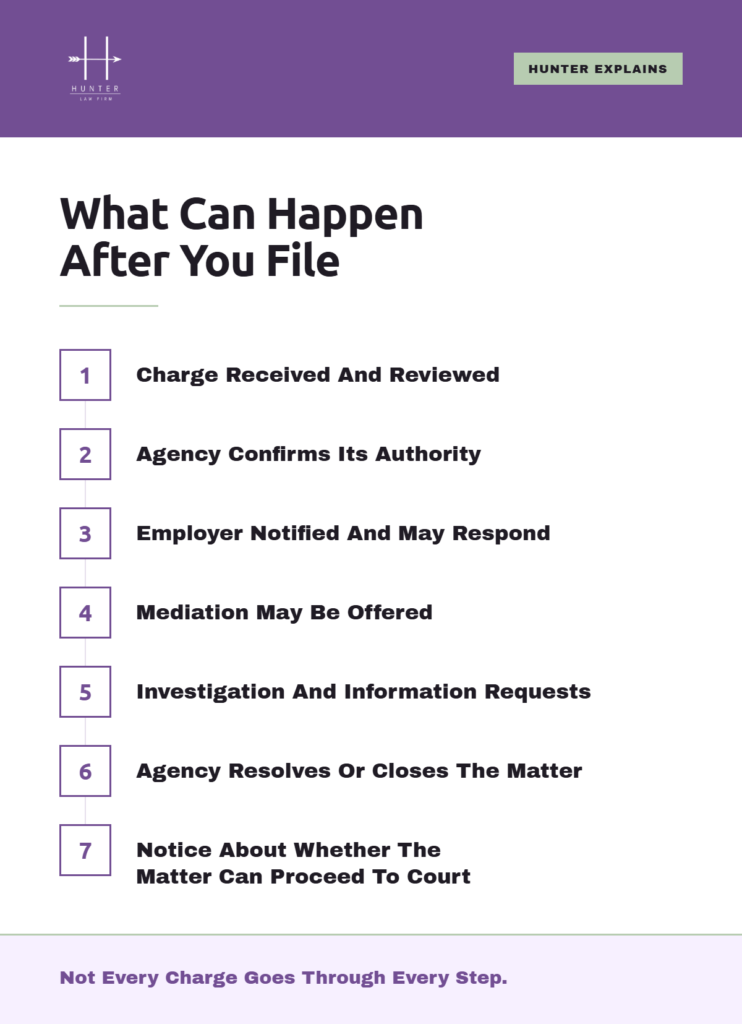
Although the exact path depends on the agency and the individual charge, the process may include these stages:
- The charge or complaint is received and reviewed.
- The agency determines whether it has authority to address the allegations.
- The employer may receive notice and an opportunity to respond.
- The parties may be offered or request mediation.
- The agency may investigate and request documents, statements, or other information.
- The agency determines how to resolve or close the administrative matter.
- Depending on the law and procedural path, the employee may receive notice affecting whether the matter can proceed to court.
Not every charge goes through every step, and an administrative filing is not itself a determination that unlawful discrimination occurred.
Where do Tennessee employees file: the EEOC or CRED?
Tennessee employees may encounter two different agencies when dealing with employment discrimination.
The U.S. Equal Employment Opportunity Commission, or EEOC, administers federal employment discrimination laws.
At the state level, employment discrimination complaints under Tennessee law are now handled by the Civil Rights Enforcement Division, or CRED, within the Tennessee Attorney General’s Office. CRED took over these enforcement functions after the Tennessee Human Rights Commission was dissolved in 2025.
Which agency and which legal claims matter can depend on the facts.
There are also important timing issues involving administrative charges and court claims.
Hunter Employment Law’s current public-facing guidance is generally:
- 180 days to file with the EEOC or CRED
- One year to file a cause of action under the Tennessee Human Rights Act
- Filing with the EEOC or CRED does not extend the one-year THRA limitations period
For a fuller explanation of timing, see How Long Do I Have to File a Discrimination or Harassment Claim in Tennessee?
What happens during EEOC intake?
An EEOC inquiry and an EEOC charge are related, but they are not necessarily the same step.
During intake, the agency may gather information about the employer, the employee, the workplace events, and the type of discrimination or retaliation being alleged.
A formal charge identifies the parties and describes the alleged discriminatory conduct.
Once a charge has been filed, the employer may receive notice.
That notice does not mean the EEOC has concluded that the employer violated the law.
It means allegations have entered the administrative process for evaluation.
What happens when a complaint is filed with Tennessee CRED?
CRED investigates complaints of discrimination and retaliation under Tennessee law, including employment complaints under the Tennessee Human Rights Act.
According to CRED, a complaint must be filed within 180 days after the last discriminatory act. Filing with CRED is not required before filing a lawsuit under the Tennessee Human Rights Act or the Tennessee Disability Act, and filing with CRED does not extend the one-year period to file that lawsuit.
CRED is a government enforcement agency. It is not the individual employee’s private attorney.
An employee may choose to retain private counsel during the process.
What happens when the employer responds to an EEOC charge?
An employer generally has an opportunity to respond to the allegations.
The agency may request a written position statement explaining the employer’s factual or legal position.
The employee may also have an opportunity to respond to information submitted by the employer.
The agency may ask questions, request records, interview witnesses, or seek other information relevant to the allegations.
This part of the process can matter because workplace disputes often involve very different accounts of what happened.
An employer may say a termination was based on performance.
An employee may believe the stated reason changed only after she complained about harassment.
An employer may describe an accommodation as unreasonable.
An employee may have months of communications showing repeated attempts to identify workable options.
Documents, chronology, witnesses, and consistency can all matter when the agency evaluates competing explanations.
What happens during an investigation?
An investigation is a fact-gathering process.
Depending on what the agency needs to evaluate, investigators may request documents, seek written responses, interview witnesses, ask follow-up questions, or gather other information.
The exact scope varies from matter to matter.
An administrative investigation is also different from a court case.
The investigator is not a personal attorney for either side, and the administrative process does not operate exactly like civil litigation.
During the process, employees should generally keep their contact information current and pay attention to agency communications and requests.
If something significant happens at work while the matter is pending, that new event may create additional procedural questions.
Can an EEOC charge go to mediation?
Yes.
Some EEOC matters may be offered for mediation.
Mediation is a voluntary process in which a neutral mediator helps the parties explore whether the dispute can be resolved.
The mediator does not decide who is right or wrong.
If mediation does not produce an agreement, the matter may return to the administrative process.
An offer to mediate also does not mean the agency has already decided the merits of the claim.
Administrative mediation is different from the private mediation that may occur outside the agency process or later in litigation.
For more on private resolution options, see Lawsuits and Litigation Aren’t Your Only Option.
What is a right-to-sue notice?
For certain federal employment claims, a Notice of Right to Sue is a procedural notice that may allow the employee to pursue those claims in court.
It is important to understand what the notice does, and what it does not do.
A right-to-sue notice is not the same thing as winning a case.
It also does not necessarily mean the EEOC found discrimination.
The notice concerns the employee’s ability to move from the administrative process into litigation under the applicable federal law.
Once a notice is issued, important filing periods may apply.
For that reason, a right-to-sue notice should not simply be set aside.
See Hunter Employment Law’s current Tennessee employment discrimination deadline guide for deadline information.
What if I am still employed while my charge is pending?
Filing a discrimination charge does not require that you have already been fired.
Some employees remain with the same employer during part or all of the administrative process.
Federal and state law may protect employees from retaliation for certain protected activity, including filing a discrimination complaint.
Retaliation is also not limited to termination.
Depending on the circumstances, it may involve discipline, undesirable assignments, schedule changes, exclusion from opportunities, or other materially adverse treatment.
That does not mean every negative event after a complaint is retaliation.
Timing, decision-makers, stated reasons, comparisons, prior history, and other evidence can matter.
If something significant changes after your filing, keep a factual record of what happened and when.
Do not take confidential employer information, trade secrets, another employee’s records, or documents you are not entitled to possess.
Read more about workplace retaliation.
When does it make sense to talk to a lawyer during this process?
You are not required to have a private lawyer simply to file a charge with the EEOC or a complaint with CRED.
Whether it makes sense to seek legal advice during the process depends on the circumstances.
Legal advice may be particularly useful when:
- You are uncertain which legal claims may apply
- Your employer has submitted a position statement containing disputed facts
- Important new events occur after filing
- You are offered a settlement
- You are considering mediation
- You receive a right-to-sue notice
- You remain employed and believe retaliation or additional discrimination may be occurring
- The employer asks you to sign a release, severance agreement, or other document affecting legal rights
- You are unsure how an administrative filing interacts with a separate court deadline
An attorney evaluating the matter will still examine the underlying facts, evidence, applicable law, and procedural posture.
Filing a charge does not itself determine whether a firm will accept a case.
For more on that evaluation, read Why Won’t an Attorney Take My Employment Case?
What should I have ready for a case evaluation after filing?
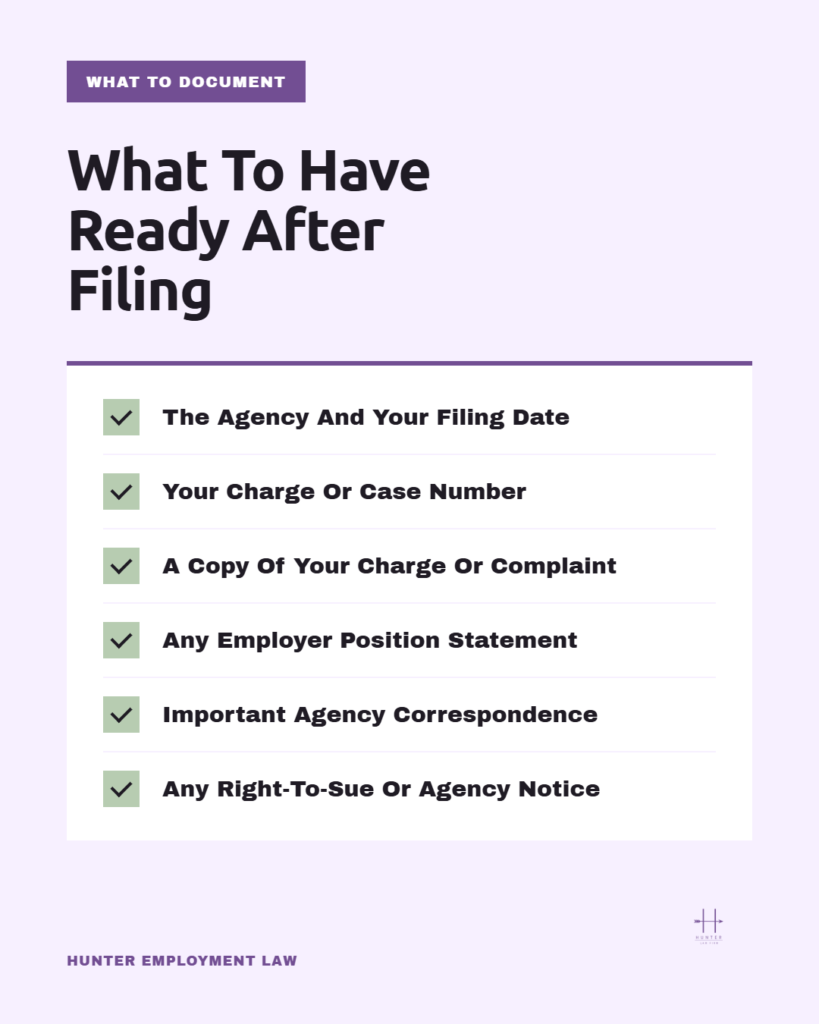
If you have already filed with the EEOC or CRED, it can help to provide:
- The agency where you filed
- Your charge or complaint date
- Your case or charge number, if available
- A copy of the charge or complaint
- Any employer position statement or response you received
- Important agency correspondence
- A short timeline of events
- Significant developments that occurred after filing
- Any mediation, settlement, or severance proposal
- Any right-to-sue or other agency notice
Request a case evaluation
Hunter Employment Law represents Tennessee employees and executives in selected discrimination, harassment, retaliation, disability, and other employment matters.
If your situation may fit the firm’s practice, you can submit a case evaluation with the information you have available.
Submitting a case evaluation does not create an attorney-client relationship.
Request a Confidential Case Evaluation
Frequently Asked Questions
Does filing an EEOC charge mean the EEOC believes my employer discriminated?
No.
A charge begins an administrative process. It is not a finding that the allegations have been proven.
Will my employer find out that I filed an EEOC charge?
A formal EEOC charge generally involves notice to the employer as part of the administrative process.
Can I settle during the agency process?
Potentially.
The EEOC process may include opportunities for voluntary resolution, including mediation.
Whether particular settlement terms make sense depends on the facts.
Can I talk to a lawyer before the agency finishes investigating?
Yes.
An employee does not generally have to wait until the administrative process is finished before seeking private legal advice.
What if something else happens at work after I file?
Document the new event factually and pay attention to agency procedures.
A new employment action may create additional legal or procedural questions, including possible retaliation issues.
If something significant changes while your matter is pending, consider whether legal advice would help you understand the next step.
This post is for general educational purposes and is not legal advice. Every situation depends on specific facts.


