
Short answer: Employment lawyers usually decline a case for one of six reasons: the facts do not connect to a legal protection, a filing deadline has passed or is close, the employer is not covered by the law that applies, the evidence is thin, the harm is limited, or the matter falls outside the firm’s practice or capacity. A decline is not a finding that nothing serious happened.
Being turned down by an employment lawyer can be frustrating, especially when what happened at work felt clearly wrong.
Understanding the reason for a “no” can help you decide what to do next.
Why do employment lawyers decline cases?
Employment lawyers decline cases when the facts, the law, the timing, and the firm’s practice do not line up. Not every unfair workplace decision is unlawful.
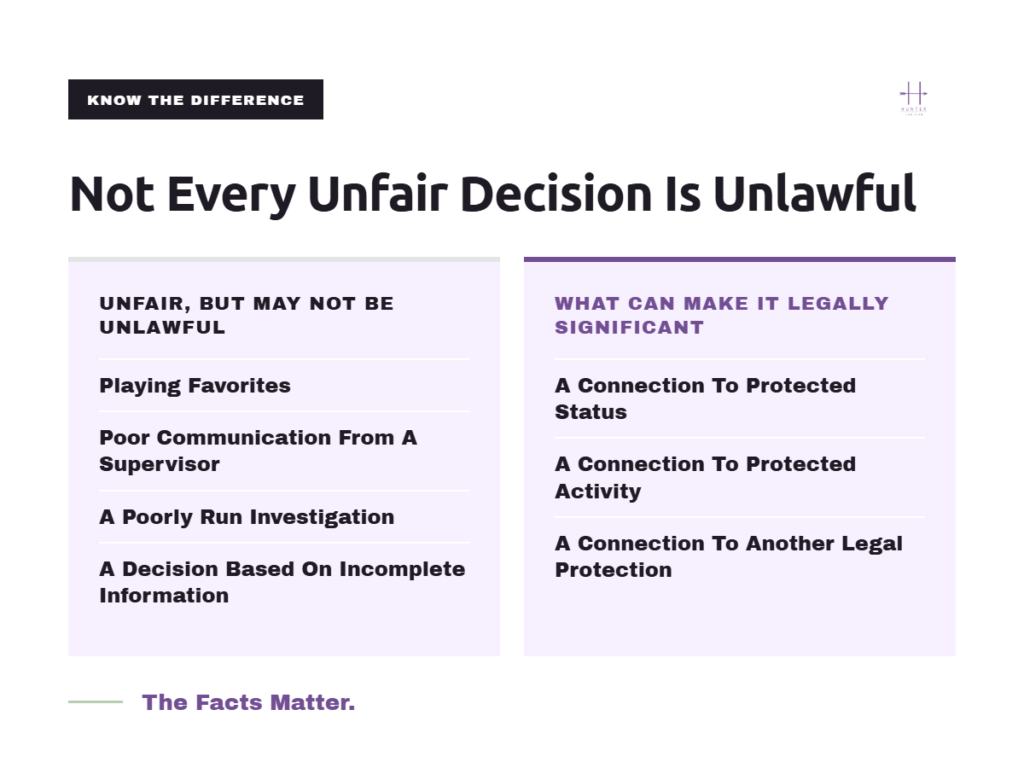
A manager may play favorites. A supervisor may communicate badly. A company may conduct an investigation poorly. An employer may make a decision based on incomplete information.
Those situations can have serious consequences for an employee. But a legal claim usually requires a connection to a particular legal protection.
That is why employment attorneys tend to ask questions such as:
- What happened?
- When did it happen?
- Who made the decision?
- Why does the employee believe the decision happened?
- Was discrimination, harassment, retaliation, disability, protected activity, leave, or another legal right involved?
- How large is the employer?
- What documents, witnesses, communications, or other evidence may help establish what happened?
- What losses or other harm resulted?
The answer can also depend on which law applies.
The conduct may have been unfair without being unlawful
One of the hardest parts of employment law is the distinction between conduct that feels wrong and conduct that violates the law.
Tennessee generally follows at-will employment principles. At-will employment does not give employers permission to discriminate or retaliate unlawfully, but it does mean that an unfair termination is not automatically an illegal termination.
In Tennessee, an unfair termination is not automatically an unlawful one. What usually matters is whether the decision is connected to protected status, protected activity, or another legal protection, such as discrimination, harassment, retaliation, or disability rights.
Learn more about wrongful termination in Tennessee.
For another example of the difference between unacceptable conduct and conduct that may satisfy a legal standard, see our discussion of workplace harassment versus workplace annoyance.
The facts may not show a connection to a protected characteristic or protected activity
Discrimination claims generally involve an employment decision or workplace treatment connected to a legally protected characteristic.
Depending on the law involved, protected characteristics may include race, color, religion, sex, national origin, disability, age, genetic information, and other protected statuses. The Tennessee Human Rights Act, for example, covers race, creed, color, religion, sex, age, and national origin. Retaliation protections may also apply when an employee engages in certain legally protected activity.
The legal question is usually not simply whether the employee belongs to a protected group.
It is whether the available facts may support a connection between the protected characteristic or protected activity and what the employer did.
That connection may be evaluated through timing, comparative treatment, changing explanations, workplace communications, decision-maker conduct, patterns, and other evidence.
Timing may affect the available options
Employment claims can involve important filing periods and procedural requirements.
Waiting too long can limit available legal options even when the underlying events are serious.
For Tennessee discrimination and harassment matters, Hunter Employment Law’s current public-facing guidance is generally:
- 180 days to file with the EEOC or CRED
- One year to file a cause of action under the Tennessee Human Rights Act
- Filing with the EEOC or CRED does not extend the one-year THRA limitations period
Because the correct deadline can still depend on the claim and procedural path, review our current guide to deadlines for Tennessee discrimination and harassment claims rather than relying on a general number found elsewhere online.
Employer size may matter
Some employment statutes apply only to employers meeting minimum size requirements. For example, Title VII and the Americans with Disabilities Act generally apply to employers with 15 or more employees, while the Tennessee Human Rights Act generally applies to employers with 8 or more employees in Tennessee.
For that reason, an attorney may ask how many people the employer has, whether the employer is part of a larger organization, where employees work, and which entity actually made the employment decision.
Employer coverage can be legally complicated, so a rough headcount is not always the end of the analysis.
The type and extent of harm may matter
An attorney may also look at what happened after the alleged unlawful conduct.
Was the employee fired?
Demoted?
Denied a promotion?
Placed on unpaid leave?
Subjected to a materially different schedule or assignment?
Did the conduct affect compensation, benefits, or future employment?
Was the person subjected to harassment while remaining employed?
The existence of damages does not determine whether conduct was lawful or unlawful, but the consequences can affect how a firm evaluates a potential matter.
For questions about potential value and litigation timing, see How Much Money Is My Case Worth and How Long Will It Take?
The claim may fall outside the firm’s practice
Not every employment firm handles every type of workplace problem.
A firm may focus on employee-side discrimination and retaliation while declining individual wage disputes, workers’ compensation cases, union disputes, tenure matters, or other employment-related issues.
A decline sometimes reflects practice fit rather than a conclusion that the employee has no rights.
The firm may not have capacity for the case
Employment litigation can require substantial attorney time, document review, investigation, discovery, motion practice, and trial preparation.
A law firm must consider whether it has the capacity to give a matter the attention it requires.
That means two attorneys can hear the same facts and make different decisions about whether the matter fits their practices.
A firm declining a case does not automatically answer what another qualified employment lawyer may decide.
What employment matters does Hunter Employment Law generally handle?
Hunter Employment Law focuses on discrimination, harassment, retaliation, ADA and accommodation disputes, and executive employment matters for Tennessee employees and executives. As a boutique employment and civil rights firm, our work generally includes issues such as:
- Sexual harassment and hostile work environments
- Sex and pregnancy discrimination
- Disability discrimination and workplace accommodations
- Race discrimination
- LGBTQIA+ discrimination
- Retaliation connected to legally protected conduct
- Employment discrimination involving professionals and executives
- Executive employment agreements, severance, and restrictive covenants
Hunter generally prioritizes matters where the facts, applicable law, and potential evidence fit the firm’s employment and civil rights practice.
As general case-selection priorities, Hunter generally does not take:
- General wrongful termination matters without discrimination, retaliation, protected activity, or another recognized legal basis
- Small-employer disputes, subject to case-specific exceptions where the facts support another viable legal theory within Hunter’s practice, including certain sexual-harassment matters
- University tenure disputes
- Claims against the State of Tennessee where sovereign-immunity barriers make the matter unsuitable
- Individual wage-and-hour matters, unless the matter may support class or collective action
- Defamation or libel unrelated to employment law
- Matters based only on a misunderstanding of Tennessee at-will or right-to-work concepts
That is a description of Hunter Employment Law’s case-selection focus. It is not a conclusion about whether another attorney or another type of legal practice could assist with a particular problem.
I received a right-to-sue notice. Will a lawyer be more interested now?
Not automatically. A right-to-sue notice changes the procedural posture of a federal employment matter, but it does not make the underlying claim stronger or guarantee that a lawyer will accept the case.
What the notice does change is time. For most federal discrimination claims, a lawsuit generally must be filed within 90 days after the notice is received, so the notice should not be set aside.
If you have already filed a charge or received a notice, read After You File: What Happens With an EEOC or Tennessee Discrimination Charge for an overview of the process and our Tennessee discrimination and harassment deadline guide for timing information.
I haven’t been fired yet. Can a lawyer still help?
Yes, in many situations. Potential employment claims are not limited to people who have already been terminated.
An employee may be dealing with harassment, discriminatory discipline, a denied accommodation, retaliation, a demotion, a leave problem, a threatened termination, or another workplace action while still employed.
Some employees also contact an attorney because they are trying to understand a developing situation before making a consequential decision.
The right strategy depends heavily on the facts.
Reporting discrimination or participating in an EEO process can be protected activity under applicable law, and retaliation can involve more than termination.
Learn more about retaliation in the workplace.
HR offered me a settlement or severance agreement. Should I sign it?
Not before you understand what you would be giving up. A severance agreement usually asks you to release legal claims, and it can affect other important rights and obligations.
Employees considering one may want to understand what they would be releasing, what compensation or benefits are being offered, whether restrictive covenants apply, and whether negotiation is appropriate before signing.
Because the right approach depends on the agreement and the circumstances, a severance offer should be evaluated on its own terms.
Read more about severance agreement review and negotiation.
Every lawyer has said no. What should I do now?
Start by identifying why the lawyers declined.
There is a meaningful difference between:
- “The facts do not appear to fit the law this firm handles.”
- “The employer may not be covered by the relevant statute.”
- “An important filing period may have expired.”
- “The potential matter is outside our practice.”
- “We cannot take on another case of this type right now.”
If the explanation is unclear, you can ask whether the decision was based primarily on legal fit, the type of matter, timing, or firm capacity. The lawyer may or may not be able to provide a detailed explanation.
It can also help to separate the emotional truth of what happened from the legal question.
Being treated badly at work matters. But employment law does not provide a legal remedy for every form of mistreatment.
Understanding that distinction can help you focus on the facts that determine whether legal protections may apply.
What should I have ready for an employment case evaluation?
You do not need to arrive with your case completely organized or know which law applies.
It does help to have a clear factual timeline.
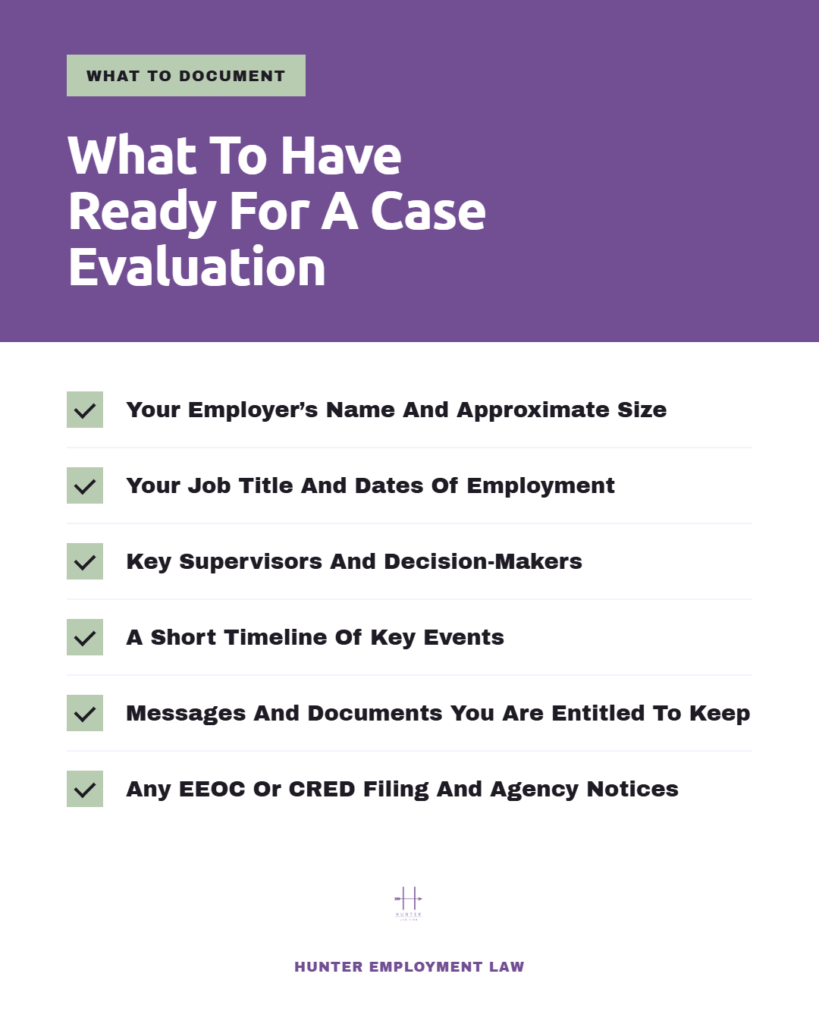
Before completing Hunter Employment Law’s case evaluation, gather what you can reasonably and lawfully access, including:
- Your employer’s full name and approximate number of employees, if known
- Your job title and dates of employment
- The names and roles of key supervisors or decision-makers
- A short timeline of the most important events
- What happened to you and when
- Why you believe discrimination, harassment, retaliation, or another employment right may be involved
- Relevant emails, text messages, evaluations, disciplinary notices, or HR communications that you are entitled to possess
- Information about complaints or reports you made
- Any responses you received from HR or management
- Termination, demotion, leave, accommodation, or severance documents, if applicable
- Information about an EEOC or CRED filing, if one exists
- Any right-to-sue or agency notice you have received
- Upcoming dates involving a severance offer, administrative matter, or other employment decision
Do not take confidential company information, trade secrets, another employee’s records, or documents you are not entitled to possess simply to prepare for a legal evaluation.
A concise timeline and the key documents are usually more useful than hundreds of unrelated pages.
Request a case evaluation
If your situation involves workplace discrimination, harassment, retaliation, disability rights, or another matter within Hunter Employment Law’s practice, you can submit a case evaluation.
The evaluation gives the firm information needed to consider the nature of the workplace issue, important dates, employer information, and whether the matter may fit Hunter’s practice.
Submitting a case evaluation does not create an attorney-client relationship.
Request a Confidential Case Evaluation
Frequently Asked Questions
Does being fired unfairly mean I have a wrongful termination case?
Not necessarily.
Tennessee generally follows at-will employment principles. A termination may feel unfair without violating an employment law. A potential legal claim usually requires an additional basis, such as prohibited discrimination, unlawful retaliation, violation of protected rights, or another recognized legal theory.
Learn more about wrongful termination in Tennessee.
Can I have a discrimination case without direct proof that my employer discriminated?
Potentially.
Employment cases do not always come with an email or statement expressly admitting discriminatory intent. Lawyers may evaluate timing, comparisons with other employees, inconsistent explanations, patterns of conduct, decision-maker statements, and other evidence.
Whether those facts are enough depends on the situation.
Will filing with the EEOC make a lawyer take my case?
No.
Filing a charge begins an administrative process. It does not establish that discrimination occurred.
A lawyer will still evaluate the facts, applicable law, evidence, procedural status, and fit with the firm’s practice.
Does a right-to-sue notice mean the EEOC found that my employer discriminated?
Not necessarily.
Different circumstances can lead to a notice permitting an individual to proceed in court. The notice should be reviewed carefully because it can affect the next procedural step, but it should not be treated as an automatic finding that the employee will prevail.
How long do I have to file a discrimination charge in Tennessee?
Hunter Employment Law’s current guidance is 180 days to file with the EEOC or the Tennessee Civil Rights Enforcement Division (CRED), and one year to file a cause of action under the Tennessee Human Rights Act. Filing with the EEOC or CRED does not extend the one-year period. See our Tennessee discrimination and harassment deadline guide for details.
This post is for general educational purposes and is not legal advice. Every situation depends on specific facts.


